

Move Out Cleaning Cincinnati: A Room-by-Room Move-Out Cleaning Checklist
Moving is exhausting. Between packing, donation piles, utility transfers, and “where did we put the scissors,” cleaning can easily become the last-minute scramble that makes move-out week miserable.
This move out cleaning Cincinnati guide is built to prevent that. You’ll get a simple timeline, a realistic priority plan, and a room-by-room move-out cleaning checklist that focuses on what walkthroughs and inspections tend to notice most—without turning your day into a 12-hour cleaning marathon.
If you’re short on time, read the “Priority Plan” section first. If you want a thorough clean, follow the full room-by-room checklist.
Why move-out cleaning feels harder than normal cleaning
Move-out cleaning is different from everyday maintenance. When your place is empty, it’s like someone turned the brightness up: baseboards look dustier, smudges on doors stand out, and crumbs in cabinet corners suddenly feel obvious.
Move-out cleaning usually requires:
More detail work (edges, corners, trim, tracks)
Inside surfaces you don’t clean weekly (cabinets, drawers, appliances)
An “empty home” final pass (floors, walls, and areas behind furniture)
The good news: with a plan, it’s very doable—even if you’re juggling a tight deadline.
The best move-out cleaning timeline
A little planning saves a lot of stress. Here’s a simple timeline that works for most move-outs:
7–10 days before keys are due
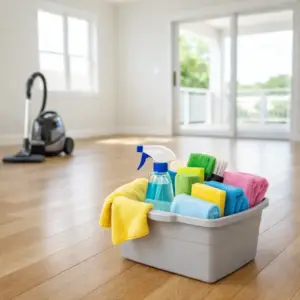
Start gathering supplies, setting aside a “cleaning tote,” and doing small tasks that take time to soak or repeat (like oven cleaning or shower buildup).
2–3 days before move-out
As rooms empty, do the deeper cleaning there. It’s easier to clean a closet when it’s actually empty.
Final day (after everything is out)
Do your walkthrough-style clean: quick wipe-downs, last-touch details, and floors last.
If you can only clean once, do it after the home is empty. That’s when you’ll be fastest and most thorough.
A realistic priority plan (if you’re short on time)
If time is tight, don’t try to do everything at the same level. Prioritize what has the biggest visual impact.
Tier 1: The “people notice this instantly” list
Kitchen surfaces and appliances, bathrooms (especially buildup), floors, and anything that looks obviously untouched (sticky cabinet fronts, fingerprints, dust on baseboards).
Tier 2: The “it looks finished” list
Doors/handles, light switches, mirrors, window sills, and inside a few key cabinets or drawers.
Tier 3: The “only if you have time” list
Blinds washed one-by-one, full wall washing, and deep detailing of every single track and vent.
You’re aiming for “clean and cared for,” not perfection at the expense of sleep.
Supplies you actually need (keep it simple)
You don’t need 15 products. A small kit covers almost everything: an all-purpose cleaner, a bathroom cleaner for buildup, a degreaser for the kitchen, glass cleaner, microfiber cloths, a scrub pad, a small brush for corners, and your vacuum/mop.
If you’re using stronger products (especially for ovens), ventilate well and follow label directions.
Move-out cleaning checklist: start with the whole-home sweep
Before you go room by room, do a quick whole-home reset. This makes everything else easier.
Remove trash and leftover items
Walk through with a bag and a box: trash in the bag, “belongs elsewhere” items in the box.Dust high to low
Ceiling corners first (cobwebs), then vents, then surfaces.Wipe the high-touch points
Doorknobs, switches, cabinet pulls—these spots show smudges fast.Save floors for last
Dust and debris fall as you clean. Floors are your final “finished” touch.
Now you’re ready to tackle rooms.
Kitchen move-out cleaning checklist (the make-or-break room)
If you only have energy for one room, make it the kitchen. It’s where grease and buildup are most obvious.
What to clean first
Start by clearing counters completely so you can wipe everything in one go. Then work in this order: counters → sink/faucet → backsplash → cabinet fronts → appliances.
Kitchen checklist (room-by-room)
Wipe counters and backsplash, paying extra attention behind the stove area
Scrub sink and faucet, including around the base where buildup forms
Wipe cabinet fronts and handles (this is where grease hides)
Clean inside cabinets and drawers that show crumbs or liner residue (vacuum corners first, then wipe)
Appliances: focus on the “inspection spots”
You don’t need to obsess over every square inch, but you should cover the areas people actually see.
Stovetop: remove loose parts if you can, degrease, and wipe under edges
Oven: wipe the door edges and inside surfaces; clean racks if time allows
Microwave: steam-clean (a mug of hot water), then wipe
Fridge: wipe shelves/drawers and the door gasket; don’t forget the bottom ledge
Dishwasher: wipe the rim and the front; remove visible debris in the filter area if accessible
Finish with the kitchen floor—vacuum edges first, then mop.
Bathroom move-out cleaning checklist (buildup is the main enemy)
Bathrooms tend to “look dirty” even after a quick wipe if soap scum or hard-water marks remain. Give buildup time to break down: spray first, let it sit, then scrub.
Bathroom checklist
Shower/tub: clean walls, corners, and the edge where grime collects
Glass doors: wipe and dry (a squeegee helps)
Toilet: clean bowl, base, and the area behind it
Vanity: clean sink, faucet, counter, and cabinet fronts
Mirror: polish and wipe edges
Exhaust fan cover: dust it—this is a small detail that makes the room look finished
Floor: sweep/vacuum corners, then mop
A small brush (even an old toothbrush) makes quick work of caulk lines and tight corners.
Bedrooms and living areas: detail work that makes the home feel “done”
These rooms are usually easier—until the furniture is gone and you notice the outlines, dust lines, and scuffs.
Checklist
Wipe baseboards and trim (even a quick pass makes a big difference)
Clean windows inside and wipe sills
Dust closet shelves and wipe any marks near the doorway
Spot clean obvious wall scuffs (especially behind where beds/couches were)
Vacuum thoroughly, including edges and corners
If you have blinds, a fast “dust and wipe” is usually enough unless they’re visibly grimy.
Closets, laundry, and utility spaces (the easy-to-forget areas)
Closets and laundry areas are classic “missed spots” because they’re not the main living spaces—but walkthroughs often include them.
Checklist
Closets: remove everything, vacuum corners, wipe shelves if dusty
Laundry: wipe exterior surfaces, vacuum lint around the dryer area
Utility/storage: sweep and remove any debris or cobwebs
This section doesn’t take long, but it prevents that “oops, we forgot the closet” moment.
Floors last: the final walkthrough-ready step
Floors are what your eyes go to immediately when you step into an empty home.
Carpet: vacuum slowly and do a second pass in high-traffic areas
Hard floors/LVP/tile: vacuum first (especially corners), then mop; avoid using too much water
Before you leave, do a final edge check along baseboards and behind doors—dust collects there.
Common move-out cleaning mistakes (and how to avoid them)
Mistake #1: Cleaning too early
If you clean while you’re still moving things out, you’ll re-dirty surfaces and miss edges. Save your final pass for the empty-home stage.
Mistake #2: Ignoring cabinet fronts and handles
Even if counters are clean, greasy cabinet pulls make a kitchen feel unclean. One quick wipe can change the whole room.
Mistake #3: Forgetting the “vertical” surfaces
Doors, light switches, trim, and baseboards are where fingerprints and dust are most noticeable.
Mistake #4: Mopping before dusting
Dust falls as you clean. Floors last is the simplest rule that prevents doing work twice.
Mistake #5: Spending too much time on low-impact tasks
If your time is limited, prioritize the high-visibility areas: kitchen, bathrooms, floors, and obvious smudges.
DIY vs hiring a move-in/move-out cleaning service in Cincinnati
DIY move-out cleaning makes sense when the home has been consistently maintained, you have enough time for details, and you’re confident handling kitchen/bath buildup and appliances.
Hiring a professional often makes sense when you’re already maxed out with packing and logistics, the home needs a more detailed reset, or you want to walk into the final walkthrough feeling confident.
If you want help with the heavy-lift details, here’s what’s included in our move-in/move-out cleaning service:
https://cincymaid.com/move-in-out-cleaning/